
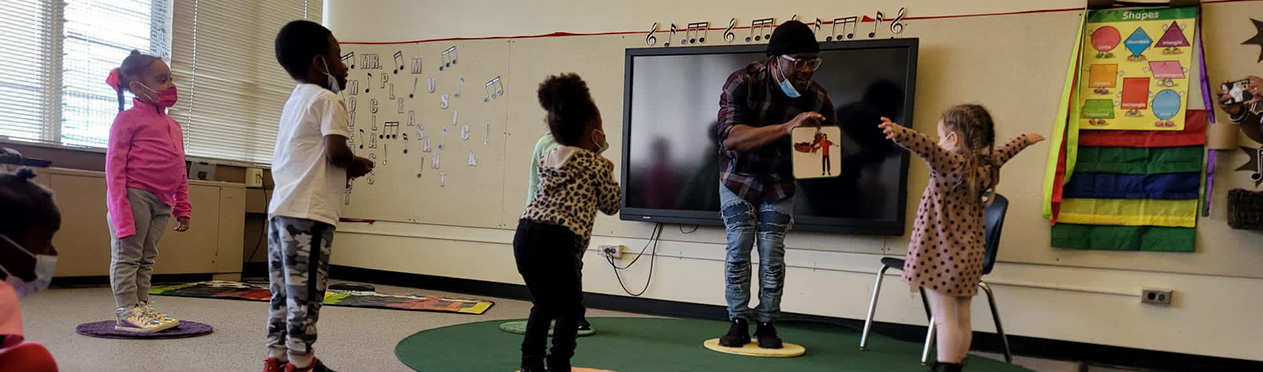
Mr. Pleasant teaching music and movement
Mr. Pleasant teaching music and movement, preschool students demonstrate mirroring with whole body shapes. Photo by Turner Cagle.

Creative Start Project Grant

Project Support for the 2027 Fiscal Year (July 1, 2026 – June 30, 2027)
This grant opens January 5, 2026.

CLICK HERE for the Creative Start Project Grant available January 5, 2026

View Application Guidelines

View Application Outline

The Creative Start Project Grant funds projects that integrate the arts to support learning for preschool to 3rd grade students. This one-year grant focuses on helping students grow creatively, academically, and emotionally, with a strong emphasis on equitable access to arts education. It encourages partnerships between educators, schools, families, teaching artists, and organizations to create inclusive and culturally responsive arts learning for students.

New to arts integration? Click here for a quick video explanation.

Funding request amounts

  • Grant amount: $6,000 or $10,000 (only full amounts are awarded)
  • No matching funds required

Important dates

  • Application opens: January 5, 2026
  • Info session: FY27 AIE Grants Info Session, January 22, 2026 Registration link 
  • Application closes: February 12, 2026, at 5:00 p.m.
  • Notification of grant award: by May 8, 2026
  • Grant-funded project activities: July 1, 2026 – June 30, 2027
  • Final report due: July 31, 2027

Application Information

Eligible applicants must be based in Washington State and be one of the following:  

  • Head Start or Early Childhood Education and Assistance Program (ECEAP) providers, their contractors and/or subcontractors 
  • Public school or School District 
  • Educational Service District (ESD)  
  • Tribal, State, or Municipal Government Agency 
  • Non-Profit with 501(c)(3) with current state corporate nonprofit status and current federal tax-exempt determination under Section 501(c)(3) of the Internal Revenue Code 

Eligible projects must: 

  • Focus on students, families, and/or educators in Washington State in any grades from preschool to grade 3 (serving all grades is not required) 
  • Focus on arts integration: teaching and learning that connects an arts discipline with non-arts curriculum in a way that meets standards and learning outcomes for both 
  • Be 100% free of charge for all participating students and families 
  • Deliver sequential arts integration teaching and learning (not one-time events) 

Who is not eligible to apply?  

  • Recipients of the ArtsWA FY26-27 AIE Sustaining Project Grant 
  • Individuals 
  • For-profit organizations 
  • Fiscally sponsored organizations 
  • Political or advocacy organizations 
  • Organizations seeking to fund projects or programs that promote religious content or observance   
  • Organizations based outside of Washington State 

Ineligible projects:  

  • Materials and equipment only (however, materials and equipment can be up to 25% of your overall project budget)  
  • One-time events, assemblies, performances, or projects that do not include sequential learning opportunities, curriculum, and related learning outcomes 
  • Tuition-based projects 
  • Projects that replace or fund in-school instruction already part of basic education 
  • Projects focused on grades 4 & up 

What we can fund:

Many costs that support the approved AIE projects can be covered. Common project expenses may include:

  • Fees for project staff:
    • Artists, teaching artists, and partnering community organizations
    • Staff time for project planning, curriculum, and resource development
    • Project management, coordination and/or in-state consultants
  • Fees for professional learning for educators, parents, caregivers, or community members
  • Travel expenses for in-state teaching artists and consultants
  • Materials, supplies, software, and technology aligned with project goals. Material costs cannot exceed: 25% of your grant request
  • Administrative expenses including printing costs, postage, and other administrative fees
  • Fees for project related student tickets and transportation expenses
  • Fees for increasing access to programming such as closed captioning, translation services, interpreters, differentiated curriculum/material development, or consultant support on these efforts

What we cannot fund:

  • Additional materials and equipment exceeding 25% of your grant request
  • One-time events, field trips, assemblies, performances, or projects that do not include sequential learning opportunities, curriculum, and related learning outcomes
  • Hospitality expenses such as food, flowers, receptions, and similar items. Exception: Food and beverages are allowed if they directly support the learning goals outlined in project
  • Building construction, renovation, event rental equipment such as tents and other temporary structures, or other permanent capital projects
  • Travel out of the state of Washington, or fees to out-of-state contractors

Applicants can apply for and receive grants from other ArtsWA granting programs if they support different expenses and services. Explore grants from other ArtsWA programs: https://www.arts.wa.gov/grants/

Not Eligible to apply: Recipients of the ArtsWA FY26-27 AIE Sustaining Project Grant

The online application includes the following required sections:

  • Eligibility Quiz – Confirms that your organization and project meet basic grant requirements
  • Applicant Information – Contact details, organization type, location, legislative district
    • 501c3 Non-Profit applicants only: Non-profit applicants must upload their Letter of Determination and provide their mission statement in the application.
  • Conflict of Interest Statement – Required review of ArtsWA’s full Conflict of Interest policy
  • ADA Compliance Verification – Confirmation that your organization and project are accessible
  • Project Information – Basic project details (title, project location(s), communities served, budget table)
  • Criteria Questions – Applicants respond to questions that align with the scoring criteria (Arts Integrated Learning, Project Design, Opportunity and Access, and Educator and Artist Support). Section includes:
    • Project Sample – Demonstrates the type of arts-integrated learning students will experience Upload one PDF document (max 5 pages) or one video file (max 5 minutes). Note: Document and video files cannot include live links to external online materials.

1. Arts Integrated Learning (30 points) 

  • Integrated Goals: Clearly connect arts and non-arts learning goals and describe how learning will be measured 
  • Student Experience: Give students meaningful, creative, and reflective learning experiences, with chances to share or celebrate their work 
  • Evidence of Learning: Include a project sample (curriculum, lesson, assessment/evaluation, student work, or video) that demonstrates what and how students will learn

2. Project Design (30 points)

  • Project Plan: Provide a clear and achievable plan aligned with organizational goals and a feasible timeline of project milestones 
  • Staffing and Partnerships: Outline strategic and feasible staffing roles and partnerships 
  • Feedback, Adaptation & Celebration: Gather feedback during the project, make adjustments as needed, and celebrate achievements with students, families, or the community

3. Opportunity and Access (20 points)

  • Community Responsiveness & Need: Reflect knowledge of your students and community, including their cultural strengths and needs, and explain why this project matters now 
  • Access & Outcomes: Use clear strategies to increase access to arts-integrated education, close opportunity gaps for students, and support positive outcomes for diverse learners

4. Educator and Artist Support (20 points)

  • Collaboration & Planning: Provide time and support for educators and artists to plan, collaborate, and refine their approach 
    • Professional Support: Ensure educators and artists are supported and offered opportunities for professional growth or learning through the project 

Submittable 

Applicants must submit their application through the online grant platform, Submittable. ArtsWA will accept applications in Submittable starting January 5, 2026, through February 12, 2026, at 5:00 p.m.

Please see ArtsWA’s Submittable FAQ for additional information on using this platform.

CLICK HERE TO APPLY

Screening for eligibility: ArtsWA staff will screen your application to make sure your application meets eligibility requirements.

Panel: A panel of arts education leaders, ArtsWA Commissioners, and staff evaluate eligible grant applications. Panelists use the scoring criteria to give a numerical score (0-100) to each application. Final scores are determined by the combined average of all panelists’ scores plus points added for applications that meet agency funding priorities (see below). Applicants receive funding based on the final ranking score order until available funds are exhausted.

All eligible organizations and projects are encouraged to apply and will be scored by a panel using the scoring criteria above.  

ArtsWA Arts in Education grants are supported by a combination of state and federal funds (from the National Endowment for the Arts). Allotments to support Arts in Education grants are limited and subject to change each fiscal year. Due to funding limitations, ArtsWA applies priorities to ensure that funds reach a variety of learning communities and geographic locations.  

Up to 20 additional points will be allotted to applications that meet the funding priorities below.     

  • The majority of the project serves early learning students and/or educators located in counties identified by the Employment Security Department as a distressed area in the 2024 Distressed Areas list. Note: Distressed area status is determined by the state each year. For the purpose of this grant cycle, eligibility will be based on county designations in effect at the time of application. (10 points). 
  • The project serves Title I schools, Head Start, ECEAP, or arts/community organizations where at least 40% of early learners are from low-income households. (10 points). 

Documentation required: Upload proof of Title I designation, % of students eligible for free/reduced-price lunch, Head Start/ECEAP eligibility guidelines, census data, or a signed statement confirming % of participants from low-income households. File types: PDF, PNG, or JPEG. 

Board Approval: Recommendations will go to the ArtsWA Board for approval by May 5, 2026. 

Notification of grant award: ArtsWA will send notifications to Arts in Education (AIE) Project Grant applicants as soon as possible after the ArtsWA Board of Commissioners meets and approves final panel scores. Applicants will receive notifications via email May 8, 2026.   

Organization Identifiers:

UEI (SAM): Organizations must have a Unique Entity ID (UEI) to receive grant funds from the state. The UEI is a 12-digit alphanumeric identifier through SAM.gov. Anyone with a current registration at SAM.gov now has a UEI. To view your UEI in SAM.gov, log in to your registration and follow the steps outlined in this guide.

Federal Tax ID (EIN): An EIN is a federal tax ID number for businesses, tax-exempt organizations and other entities. You can get an EIN for free directly from the IRS in minutes. Apply online.

SWV number: Organizations must have an SWV (Statewide Vendor) number to receive grant funds from the state. Applicants do not need an SWV number to apply but they must have a registered and up to date SWV number before they can receive funds. The SWV number registration process can take up to three weeks. If your organization has received payment from Washington State in the past, it is likely you already have an SWV number. You can check on the status of your SWV number by using the vendor number lookup.

Payments: ArtsWA will send payments after the recipient’s deliverables are completed and approved. Grant recipients are paid in two (2) equal payments per fiscal year after Project Updates are completed and approved.

Documentation: Grant recipients must track expenses, keep clear records/receipts, and provide appropriate and timely documentation.

Final report: Grant recipients must submit a final report to ArtsWA by July 31 of each fiscal year after projects have been completed.

Accessibility: Federal and state funded projects must be accessible to people with disabilities. You can use this accessibility checklist when planning your programs. You do not need to check all boxes to be eligible for funding; this is simply a worksheet and resource for your organization.

ArtsWA accepts grant applications via an online form. If you require an alternate format or assistance to access the application, please reach out to us at the contact information below or Alexis Sarah, ArtsWA Accessibility Coordinator, alexis.sarah@arts.wa.gov or at 360-228-6359.

Civil Rights: All applicants for public funding (state or federal funds) are required to certify that they are following the civil rights statutes that govern nondiscrimination in Federally assisted programs. For a FAQ on Civil Rights for applicants and to ensure your organization complies, click here.

Appeals: Unsuccessful applicants can appeal in accordance with Washington Administrative Code (WAC) 30.12.036, found here: http://app.leg.wa.gov/WAC/default.aspx?cite=30-12-036.

Contact us

Alexis Sarah, AIE Project Manager at 360-228-6359 or alexis.sarah@arts.wa.gov

Kalei Matsui, AIE Program Coordinator at 360-252-9987 or kalei.matsui@arts.wa.gov 

Translate